Monday, March 7, 2011

Recent Fascination with Unframed Canvases


The techniques of an artist are typically analyzed by color palette, brush strokes, thick paint application and licked surfaces among so many others. Yet lately, from my observations of a Contemporary Korean art exhibit, I noticed that the artist's use of the sides of their canvas adds to their work on the main, frontal plane. It has now become a bit of a game for me to decipher something new from these four surfaces attached to the central and grand spectacle of the work.

I have noticed that artists usually do not really acknowledge these parts of the canvas and do not paint them with the main subject. Often times, there is simply a small bit of paint touching these planes; remnants of trying to paint solely on the front of the canvas. However, even with this intention, or lack of intention, to add anything to the sides, there is variation- watercolors, oil, acrylic, collage, these media all act differently. Along with the materials comes the position of the canvas when it was painted/collaged/drawn on.

One of my personal favorite effects on the canvas edges is dripping paint from the canvas being painted completely horizontally. Gravity pulls the paint to the back of the canvas and onto the floor. When the canvas is then dry and hung vertically on a wall, the work is perceived in a different manner than it was created, and this can be determined purely from the drips. In a similar manner, angled drips mean a whole other thing. Angled drips mean that an easel was used. I find it entertaining to guess what angle the artist's easel was based on the drips. Perhaps this is all a pointless analysis of art, but it could hold something interesting in the idea. We all know that Pollock's drip paintings were created on the floor, but who knows what other ways these Modern and Contemporary artists are applying paint to the canvas.
 This is an exaggeration, but I couldn't find any appropriate side drips.

Lastly, there are the works that were finished and were meant to be unframed. The image wraps all the way around to the back of the canvas. The sides are used as an extension of the front plane. These are the works that I imagine the artists finished so that they could stand on their own, fully completed. Why the drips and bare edges of the canvases have not been covered? Who knows. Perhaps it is just a raw "this is what I made" sort of appearance, but no matter what, I have learned to greatly love unframed canvases. I do admit that there is nothing like a Rembrandt in its original, tattered frame, yet hte unframed works of the Contemporary art world have intrigued me. It's just one more reminder that paintings are in fact three-dimensional objects. There are multiple ways to view a work hung on a wall. Next time, take a glance on the sides or bottom and imagine the work's position in space during its creation.

Frames? Who needs them.

Thursday, February 17, 2011

Tristan Tzara: God of Dada

I love this man. He was an absolute genius and here are a couple reasons why I think that.

Excerpt from Dada Manifesto on Feeble Love and Bitter Love
12 December 1920

VII
 
A priori, in other words with its eyes closed, Dada places before action and above all: Doubt. DADA doubts everything. Dada is an armadillo. Everything is Dada, too. Beware of Dada.
 
Anti-dadaism is a disease: selfkleptomania, man's normal condition, is DADA.
But the real dadas are against DADA.
 
The selfkleptomaniac.
 
The person who steals - without thinking of his own interests, or of his will - elements of his individual, is a kleptomaniac. He steals himself. He causes the characters that alienate him from the community to disappear. The bourgeois resemble one another - they're all alike. They used not to be alike. They have been taught to steal - stealing has become a function - the most convenient and least dangerous thing is to steal oneself. They are all very poor. The poor are against DADA. They have a lot to do with their brains. They'll never get to the end of it. They work. The poor are against DADA. He who is against DADA is for me, a famous man said, but then he died. They buried him like a true dadaist. Anno domini Dada. Beware! And remember this example. 


8 April 1919

Wednesday, February 16, 2011

Artist of Freedom?

As seen in this article, Jasper Johns has been awarded the Medal of Freedom. He is one of the important 14 Americans to receive it this year, and is recognized for his patriotism, however, I am awfully baffled by him being listed with former president George H. W. Bush and John Lewis.

I'm not much of a Pop Art type of person, but I feel that I understand the general ideas behind it and understand its necessary role in the history of art. Yet Jasper Johns, being known as a Pop Art pioneer, has won this national, President-given award. I honor and respect the time Johns spent in the Army. I know that he has a background regarding Uncle Sam particularly during the Cold War. However, There are thousands of other citizens who experienced the same things, some even with Johns. His symbolic works with the American flag certainly stand for his patriotism, but I honestly don't see exactly how this is worthy of a freedom award. His art is a commentary on America, but what does it say? To me, it truly is patriotism, but this isn't a patriotism award, is it? If it is, I know an awful lot of people who do literally bleed red, white and blue that could put up a fight against Johns for the honor. Perhaps I am missing something. I'm incredibly happy that a painter has been awarded this medal alongside other artists such as Maya Angelou and Yo-Yo Ma, but I just don't see it.

In an interview with G. R. Swenson, Johns says that while the artist has an intention with his work, it is up to the viewer to find a meaning in it. Even if the viewer's interpretation is different than the artist's intention, it will still stand true. Johns gives the viewer the power of interpretation. I, as the viewer, do not see an activist or a pure sense of patriotism from the art of Johns, and these are the things I could validate this award with. I do consider the American flag as a symbol of freedom. I am proud to be American and am grateful for the rights I have in this country. However, I do not understand this choice in honor.

I ma y have gotten carried away and have implied that I am anti-Jasper Johns, but that is not true. He truly is an American artist and I respect his style, technique, and his legacy, yet grouping him with a former president? I just don't see exactly how he got here.

Then again, I suppose a Polish "All-American" baseball star, Stan Musial, has also received this Medal of Freedom. In this case, every American deserves this award.

Jasper Johns, Three Flags 1958

Thursday, February 10, 2011

Ongoing conflict

         I will begin with explaining my ongoing conflict within my own art between text and image. I love everything visual about paintings and drawings yet there has always been something inside of me that calls out towards the power of words. Words are solid, predefined objects that can rarely be altered. They are the objective, even in the most descriptive and painterly writings. Run means walking quickly or a small rip in ladies hose or what a politician might do in the next election. There are meanings. One could next to never redefine the word "run" efficiently, which is why it is so powerful. There is no alteration allowed with words; they do in fact mean what they are defined as. Nothing else would ever suffice as a definition at this point in the literary world. From this, I find words to be incredibly objective, in the best possible way of course. I feel that because of their solid meaning, they express purely what one is feeling or trying to articulate.
         I've never been to great at writing, nor at illustrations, yet, I feel that a combination of the two can result in something phenomenal. First, however, I must explain the subjectivity of the image in relation to text.
         An image consists of lines in different forms, unique colors and pigments, and shapes. Every artist has his or her own theory on a circle, a swirling line or the color cobalt blue. However, it is exactly that which makes the image so subjective. Colors can be redefined through a simple painting. Sure, there are some connotations with colors such as during Picasso's "Blue Period" when his works had a blue tint to them, when it is assumed that he was in a depressed and saddened state. This can be verified as his close friend had passed away just before this artistic shift, however, blue now holds this as a connotation. However, this assumption of blue=sadness can easily be overcome by a work which uses the same blue but in a much different manner. Franz Marc's work Blue Horse is not a symbol of sadness. It overcame that connotation for the color and created an entirely new feeling and sensation for the hue. It is because of this that I find imagery to be more subjective than text. Colors, line, form, they can all be redefined through a single work and from that, the works can be perceived in many more ways than a text filled with predefined words.
         Simply put, based on how I view both text and image, I feel that a mixture of the two is prime. Text is the art form that would guarantee the message of the writer to be understood because of the verbiage. however, the always redefined aspects of an image would add a bit more of the artist's creativity to the work. I like to create within the realm of text and image with a main focus on color. Text accentuates what I express as through the color and images, yet the color also emphasizes, if done correctly, the meanings of the words within the text. The linking between these things is how I feel my art will become perfect. However, art in it's true form without text is what I would consider genius. If an artist can communicate his or her thoughts, emotions or message through color and form alone, there is no space for subjectivity. The artist has mastered ultimate communication through image.
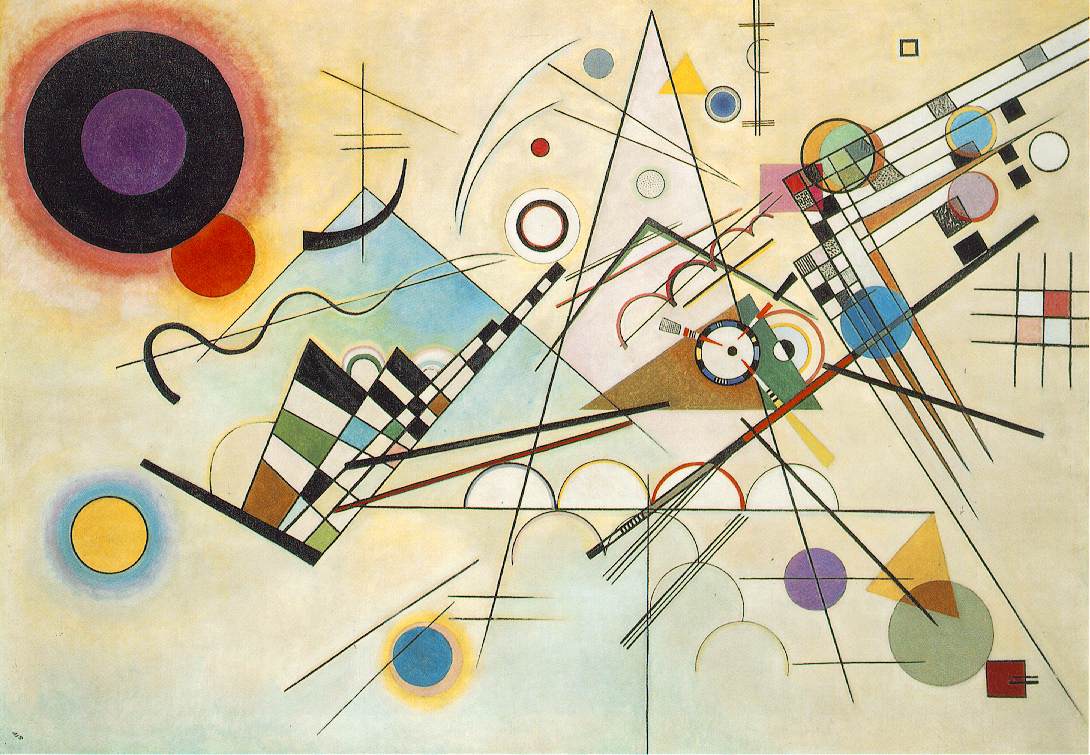
         I am not perfect let alone an artistic genius, but for some one to define colors and forms so freshly like Wassily Kandinsky, I would certainly consider them a god.
         As a side note, perhaps I should try reading A Clockwork Orange again and reevaluate my thoughts on text always having specific definitions and being objective. For now, I will stick with what I have said above.
Wassily Kandinsky, Composition VIII, 1923